What to Expect at Your First Acting Audition
Preparing for your first acting audition? Learn what to expect, how to prepare, and simple tips to help you feel confident before stepping into the audition room.
Landing your first audition is an exciting milestone.
It's also completely normal to feel nervous.
Many first-time actors wonder what they'll be asked to do, who they'll meet, how long the audition will take, or whether they'll make mistakes.
The good news is that every actor has a first audition. Casting directors understand that beginners may feel anxious, and most auditions are designed to help performers show their abilities in a professional environment.
Knowing what to expect before audition day can help you feel more prepared and confident.
In this guide, you'll learn what typically happens during a first acting audition, how to prepare beforehand, and simple ways to make a positive impression.
Before the Audition
Preparation begins long before you walk into the audition room.
Taking time to review the audition details can help reduce stress and prevent last-minute surprises.
Read the Casting Notice Carefully
One of the biggest mistakes beginners make is rushing through the casting notice.
Before audition day, read every instruction carefully.
Pay close attention to:
- Audition date and time
- Location or self-tape instructions
- Character description
- Wardrobe requests
- Required materials
- Script or sides
- Submission instructions
Missing a simple detail can create unnecessary stress and leave a poor first impression.
Learn Your Lines If They're Provided
Some auditions include a short script, often called "sides."
If you receive them in advance, spend time becoming familiar with the dialogue.
You don't always need to memorize every word perfectly unless the casting notice specifically asks you to.
Instead, focus on understanding:
- What your character wants
- The emotions in the scene
- Who you're speaking to
- The overall situation
Understanding the scene is usually more helpful than simply memorizing lines.
Research the Project
If information about the production is available, spend a few minutes learning about it.
You might look at:
- The type of project
- The production company
- Previous work from the filmmakers
- The overall tone of the project
This isn't about copying other performances.
It's about understanding the style of the production so your performance feels appropriate.
What Should You Bring?
Being prepared allows you to focus on your performance instead of worrying about forgotten items.
Depending on the audition, consider bringing:
- Printed headshots if requested
- Your acting resume
- A copy of the audition sides
- Water
- A notebook and pen
- Any requested wardrobe items
If you're attending an in-person audition, try to arrive at least 10 to 15 minutes early.
Arriving early gives you time to check in, relax, and settle your nerves before your audition begins.
What Happens When You Arrive?
Every casting office operates a little differently, but most auditions follow a similar process.
After arriving, you'll usually check in with someone at the front desk or a production assistant.
You may be asked to:
- Confirm your name
- Complete paperwork
- Wait until your name is called
The waiting room is often quiet.
Some actors review their lines.
Others listen to music, stretch, or simply relax.
Try not to compare yourself to the other performers.
Everyone is there for the same reason.
Focus on your own preparation.
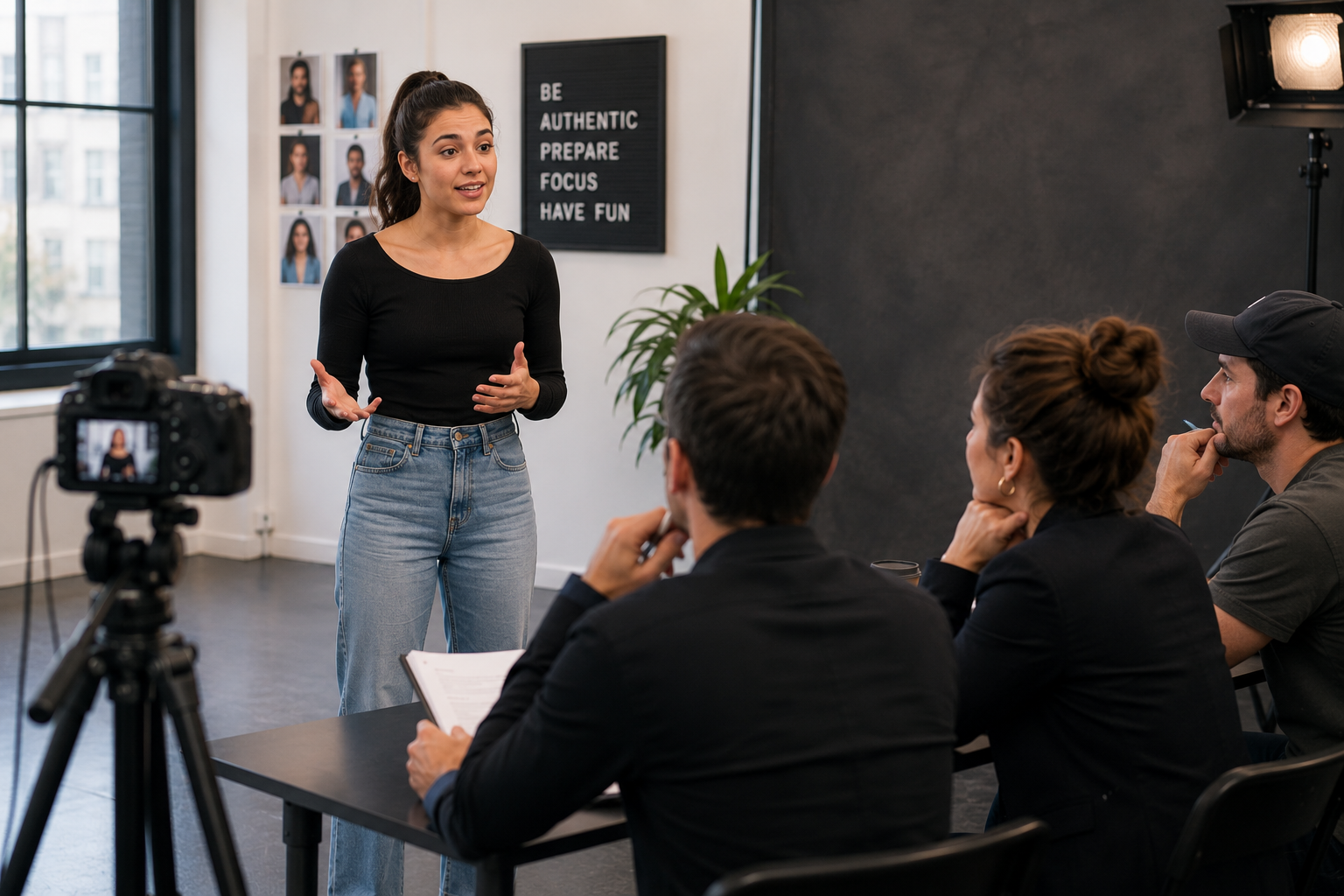
Inside the Audition Room
Walking into the audition room is often the most intimidating part for beginners.
In reality, most audition rooms are simple and professional.
You might see:
- A casting director
- A casting assistant
- A camera operator
- A reader who performs the other lines in the scene
Most rooms are intentionally free from distractions so the focus remains on your performance.
Don't worry if the casting team appears quiet while you're performing.
Many casting professionals take notes throughout auditions.
A neutral expression doesn't necessarily mean your performance is going well or poorly.
They're simply doing their job.
You'll Probably Start With a Slate
Many auditions begin with a slate.
A slate is a brief introduction before your performance.
You may be asked to say:
- Your name
- Your height
- Your agency, if applicable
- The role you're auditioning for
Keep your slate natural, friendly, and confident.
There's no need to overthink it.
Think of it as introducing yourself rather than performing.
Then You'll Perform the Scene
After your introduction, you'll perform the material you've prepared.
Focus on telling the story rather than trying to impress the casting team.
Listen carefully to your scene partner or reader.
React naturally.
Stay connected to the emotions of the scene.
If you make a small mistake, don't panic.
Many auditions continue successfully even when an actor misses a word or briefly loses their place.
Casting directors are often more interested in how you recover than whether your performance is completely flawless.
You May Be Asked to Perform the Scene Again
Don't be surprised if the casting director asks you to perform the scene a second time.
This is called receiving an adjustment.
Instead of repeating the performance exactly the same way, the casting team may give you a simple direction such as:
- "Can you make the character more confident?"
- "Let's try it with less emotion."
- "Imagine you're speaking to a close friend."
- "Slow the pace down a little."
This isn't a sign that you did something wrong.
In fact, receiving adjustments is often a positive sign. It allows the casting team to see how well you listen, adapt, and take direction.
The ability to make quick adjustments is an important skill for every actor.
What Casting Directors Are Really Looking For
Many beginners believe they need to deliver a perfect performance to book a role.
In reality, casting directors evaluate much more than memorization.
They're often looking for qualities such as:
- Authenticity
- Confidence
- Preparation
- Professionalism
- Ability to take direction
- A good fit for the character
Sometimes an actor gives an excellent performance but simply doesn't match the age, appearance, or personality the production needs.
That doesn't mean the audition was unsuccessful.
Casting is about finding the right fit for a specific project.
If You Make a Mistake, Keep Going
Almost every actor makes mistakes during auditions.
You might forget a line.
Lose your place.
Mispronounce a word.
It happens.
Instead of stopping immediately, stay in the scene whenever possible.
Casting directors understand that auditions can be stressful.
How you recover often tells them more than the mistake itself.
Remaining calm and continuing your performance demonstrates professionalism and confidence.
What Happens After the Audition?
Once you've finished performing, the casting team will usually thank you for coming.
The audition may only last a few minutes.
Afterward, your work is finished.
The casting team will review every audition before making decisions.
Some actors receive callbacks.
Others hear directly from production.
Sometimes you may not receive a response at all.
Although waiting can be difficult, it's a normal part of the casting process.
Instead of worrying about the outcome, focus on preparing for your next opportunity.
Every audition helps you become more experienced.
Common Mistakes Beginners Should Avoid
Your first audition is a learning experience.
Avoiding a few common mistakes can help you make a stronger impression.
Arriving Late
Always give yourself extra travel time.
Arriving early allows you to relax instead of rushing into the audition feeling stressed.
Ignoring the Instructions
Read the casting notice carefully before audition day.
Missing simple instructions about wardrobe, scripts, or arrival times can create unnecessary problems.
Trying to Be Perfect
Many beginners focus so much on saying every line perfectly that they forget to actually perform the scene.
Don't aim for perfection.
Focus on telling the story honestly.
Comparing Yourself to Other Actors
It's easy to feel intimidated when other performers seem experienced.
Remember that every actor brings something unique.
Casting directors aren't looking for everyone to perform the role the same way.
They're looking for the person who best fits the character.
Stay focused on your own performance.
Giving Up After One Audition
Very few actors book their first audition.
That doesn't mean you're not talented.
Each audition teaches valuable lessons that make you stronger for the next opportunity.
Think of auditions as practice as much as opportunities.
Frequently Asked Questions
How long does a first acting audition usually take?
Many auditions last between five and fifteen minutes, although the total time at the casting location may be longer if there are other actors waiting.
Do I need to memorize my lines?
If the casting notice requests memorization, you should do your best to learn the material.
If not, becoming familiar with the scene and understanding your character is usually more important than perfect memorization.
What should I wear to my first audition?
Choose clean, comfortable clothing that suits the character without looking like a full costume.
Simple outfits usually work best unless the casting notice requests something specific.
What happens if I don't get the role?
Not booking a role is a normal part of acting.
Even experienced actors audition far more often than they book jobs.
Each audition helps you gain experience and improve your skills.
Your Next Steps
Your first acting audition may feel intimidating, but every experienced actor has stood exactly where you are now.
Preparation, practice, and confidence grow with experience.
Before your next audition, remember to:
- Read the casting notice carefully.
- Prepare your material ahead of time.
- Arrive early.
- Stay professional.
- Focus on telling the story instead of trying to be perfect.
- Treat every audition as an opportunity to learn.
The more auditions you attend, the more comfortable and confident you'll become.