Commercial Auditions vs. Film and TV Auditions
Learn how commercial auditions differ from film and TV auditions, including the material, performance style, pacing, camera use, direction, and casting priorities.
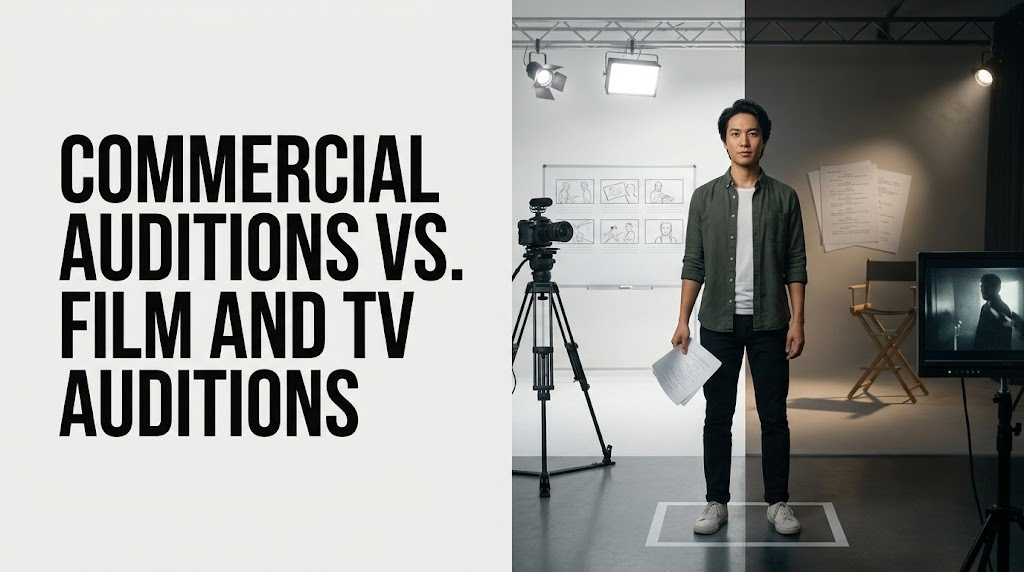
Commercial auditions and film or television auditions all ask actors to perform truthfully on camera.
However, they may not ask the actor to accomplish the same creative goal.
A commercial performance often supports a product, service, campaign, or advertising message. A film or television performance usually supports a character, relationship, and larger story.
When comparing commercial auditions vs. film and TV auditions, those different goals can affect the material you receive, the choices you make, the pace of your performance, and your relationship with the camera.
Understanding these differences can help you adapt without relying on exaggerated ideas about how commercial or dramatic acting is supposed to look.
The Creative Goal Shapes the Performance
Every audition begins with one important question:
What must this performance accomplish?
In a commercial audition, the performance may need to introduce a service, demonstrate a product, communicate a benefit, or help a brand feel relatable.
Even when a commercial contains a short story, that story usually supports a larger advertising idea.
The casting team may be considering whether your performance communicates that idea clearly and feels appropriate for the campaign's intended audience.
Film and television auditions are generally centered on character and narrative.
The casting team may be evaluating how you understand the character, connect with another person in the scene, respond to conflict, and contribute to the production's tone.
A commercial audition may therefore place greater emphasis on clarity, accessibility, and connection to the concept.
A film or TV audition may place greater emphasis on character choices, relationships, listening, and how the scene develops.
These are general differences rather than fixed rules. Some commercials are quiet and cinematic, while some film or television scenes require precise timing and carefully controlled physical actions.
The specific audition instructions should always guide your performance.
Commercial Copy and Script Sides Require Different Preparation
Commercial audition material may include:
- Short advertising copy
- A simple scenario
- Physical action
- Product interaction
- A storyboard
- An improvisation prompt
Begin by identifying the central communication goal.
Ask yourself:
- Who am I communicating with?
- What should the audience understand?
- Which words or actions must remain clear?
- What tone does the audition brief suggest?
A strong commercial performance supports the concept without sounding like a forced sales presentation.
Film and television auditions usually provide script sides taken from a scene.
When preparing those sides, consider:
- The circumstances of the scene
- Your relationship with the other character
- What your character wants
- What stands in the way
- Where the scene changes
Your analysis should lead to believable behavior rather than an attempt to demonstrate every idea you discovered in the script.
Commercial material may be shorter, but shorter does not necessarily mean easier. A few lines can still require precise timing, clear communication, natural reactions, and carefully planned physical actions.
Performance Style Should Match the Project
Commercial acting is sometimes associated with constant smiling, high energy, and exaggerated enthusiasm.
Some campaigns may require those qualities, but many do not.
A commercial can be:
- Warm
- Playful
- Serious
- Reassuring
- Restrained
- Humorous
- Emotionally intimate
Instead of adding a permanent smile or an artificial "commercial voice," connect your behavior to the situation.
Consider what interests, surprises, reassures, or motivates the person you are playing. When the reaction feels specific, the advertising message can remain clear without making the performance feel forced.
Film and television auditions may allow more attention to character relationships, emotional changes, and unspoken thoughts.
However, subtle acting should not become passive or unclear.
The actor still needs a point of view, a relationship, and a reason to speak.
Truthful behavior matters in every format. The difference is usually where the performance directs the audience's attention.
A commercial may direct attention toward the campaign's central idea, while a film or television scene may direct attention toward the character and story.
Pacing and Camera Use May Change
Commercial auditions often need to communicate an idea within a limited amount of time.
Copy, reactions, physical actions, and the central message may all need to fit within a short performance.
That can require:
- Concise pacing
- Clear thought changes
- Purposeful movement
- Accurate delivery of important words
- Smooth interaction with an object or scene partner
Concise does not mean rushed.
Allow each idea to register while keeping the performance moving.
Film and television pacing is generally shaped by the scene.
A pause may reveal a decision, an emotional change, a shift in power, or a response to something the other character has said.
The rhythm should come from listening and responding rather than from trying to make the scene appear dramatic.
Camera relationships may also differ.
Some commercial auditions ask actors to speak directly into the lens because the finished advertisement addresses the viewer. Others use an off-camera scene partner or show the actor interacting with an object.
Film and television auditions more commonly use an off-camera eyeline representing another character.
Look directly into the camera only when the material or instructions call for direct address.
Always follow the requested framing, eyeline, and movement instructions. The directions supplied for the individual audition take priority over general advice about the format.
Direction Shows How You Adapt
Casting teams may ask you to perform another take with an adjustment.
During a commercial audition, that adjustment may involve:
- Changing your pace
- Increasing or reducing your energy
- Adding more warmth
- Emphasizing an important word
- Adjusting your interaction with an object
- Changing your relationship with the camera
During a film or TV audition, the direction may involve:
- Changing your objective
- Reconsidering the relationship in the scene
- Increasing or reducing the stakes
- Adjusting the pace
- Exploring a different tone
- Interpreting a moment in a new way
Receiving direction does not automatically mean your first take was wrong.
The casting team may want to explore another possibility, compare different versions, or see how comfortably you respond to new information.
Listen carefully, make a clear adjustment, and commit to the new version.
What Casting Teams May Evaluate
Commercial casting teams may consider whether you:
- Communicate the advertising idea clearly
- Fit naturally within the campaign's world
- Appear comfortable and believable on camera
- Match the requested tone
- Interact naturally with other performers or objects
- Respond well to adjustments
Film and television casting teams may consider whether you:
- Understand the character and scene
- Listen and respond truthfully
- Make clear acting choices
- Create a believable relationship
- Support the tone of the production
- Bring the written scene to life
Preparation and flexibility matter in every format.
However, casting decisions may also depend on factors outside your control, including scheduling, appearance combinations, ensemble needs, campaign direction, or changes within the production.
Your goal is to present a prepared and appropriate interpretation—not to guarantee a particular outcome.
How to Prepare for Each Format
Before a commercial audition:
- Identify the central advertising message.
- Determine who you are communicating with.
- Mark any required words, reactions, or physical actions.
- Choose an energy level that matches the brief.
- Confirm whether you should address the camera or another person.
- Rehearse a clear and natural version.
Before a film or television audition:
- Review the circumstances of the scene.
- Define your relationship with the other character.
- Identify what your character wants.
- Consider what stands in the way.
- Mark where the scene or relationship changes.
- Rehearse while actively listening to the reader.
Before every audition, confirm:
- The submission deadline
- The requested framing
- The slate instructions
- The number of takes allowed
- The file-naming requirements
- Any wardrobe or prop directions
- Whether direct eye contact with the camera is requested
Specific instructions for the project should always take priority over general audition advice.
Common Misconceptions
Commercial Actors Should Always Smile
Not every commercial is cheerful or energetic.
Some campaigns require warmth, while others may call for concern, authority, humor, restraint, or quiet confidence.
Allow your expression to come from the situation rather than adding a smile simply because the material is commercial.
Film and TV Acting Should Be Extremely Small
On-camera acting can be detailed without becoming passive.
The viewer should still understand what matters to the character, what the character wants, and how the character responds to the scene.
Subtle acting is still active acting.
Commercial Acting Is Less Truthful Than Dramatic Acting
Commercial performances still require believable behavior.
The difference is that the performance may support an advertising message rather than a longer narrative.
Truthfulness remains important in both formats.
One Audition Style Works for Every Project
Your acting foundation can remain consistent, but your choices should adapt to the material, tone, camera instructions, and creative goal.
Avoid performing a general idea of a commercial, film, or television audition.
Focus on the specific project in front of you.
Frequently Asked Questions
Are Commercial Auditions Easier Than Film and TV Auditions?
Not necessarily.
Commercial auditions may require precise timing, clear communication, natural product interaction, and quick adjustments.
Film and television auditions may require deeper scene analysis, character work, and sustained listening.
Each format presents different challenges.
Should I Use More Energy During a Commercial Audition?
Only when the campaign tone and audition instructions support it.
Aim for connected and readable behavior rather than automatically becoming louder, faster, or more enthusiastic.
Should I Look Directly Into the Camera?
Look directly into the lens when the material uses direct address or the instructions specifically request it.
When speaking to another character, an off-camera eyeline is usually more appropriate.
Are Film and Television Auditions Exactly the Same?
They share many storytelling and on-camera skills, but their tone, pace, scene structure, and casting needs may differ between projects.
Prepare for the specific material instead of relying entirely on the format label.
Your Next Steps
Before your next audition, write one sentence describing the purpose of the performance.
For a commercial audition, identify what the audience should understand, feel, or notice about the advertising concept.
For a film or television audition, identify what your character wants and what changes during the scene.
Then:
- Review every instruction carefully.
- Choose a clear performance approach.
- Rehearse without adding unnecessary movement.
- Confirm your framing and eyeline.
- Remain open to adjustments.
- Focus on the material rather than a stereotype of the format.
You do not need to become a completely different actor for each type of audition.
You simply need to adjust your preparation and performance so they serve the project in front of you.