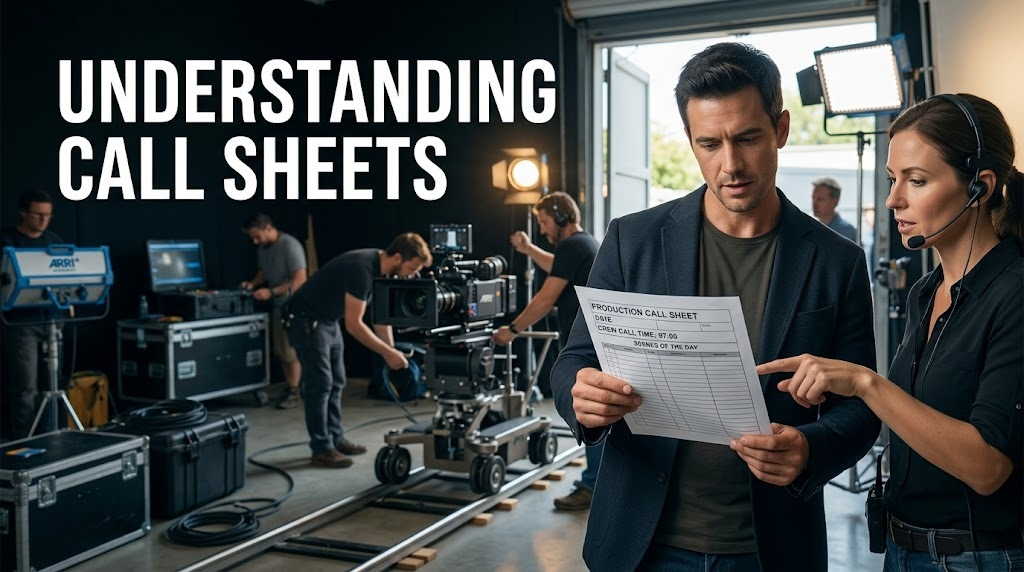
Essential Television Set Terms Every Actor Should Know
Learn common television set terminology, what these production terms mean, and how they help actors communicate confidently during episodic filming.

Television productions often move at a fast pace.
Whether you're working on a drama, comedy, streaming series, or limited series, you'll hear production terms that help cast and crew communicate efficiently throughout each filming day.
Many television terms are similar to those used on film sets, while others are unique to episodic production.
Learning this vocabulary can help you better understand instructions, communicate confidently, and feel more comfortable working on professional television productions.
In this guide, we'll introduce common television production terminology that actors are likely to encounter while working on set.
Understanding the Language of Television Production
Television productions rely on clear communication between many departments.
Because filming schedules are often fast-moving, consistent terminology helps everyone stay organized and work efficiently.
For actors, understanding common television terms can help you:
- Follow production instructions.
- Understand your role within the schedule.
- Communicate more confidently.
- Feel more comfortable on set.
As with film productions, you'll naturally become more familiar with the language through experience.
Common Terms You'll Hear
Here are several terms actors frequently encounter while working on television productions.
Episode
One individual installment of a television series.
Season
A collection of episodes produced as part of the same series.
Series Regular
A principal performer who appears consistently throughout a television series.
Recurring Character
A character who appears in multiple episodes but not necessarily every episode.
Guest Star
An actor appearing in a significant role for one or more episodes without being part of the regular cast.
Co-Star
A performer appearing in a smaller principal role, often within a single episode.
Pickup
Additional footage filmed after the original production to complete or improve a scene.
Soundstage
A purpose-built indoor filming space designed for television and film production.
Television Production Moves Quickly
Television schedules are often designed around producing multiple scenes—or even portions of an entire episode—within a limited timeframe.
Because of this, actors may notice:
- Frequent schedule adjustments.
- Multiple scene changes.
- Fast transitions between setups.
- Careful coordination between departments.
Preparation and adaptability help productions maintain their schedules.
Every Series Has Its Own Workflow
No two television productions are identical.
Depending on the type of series, production methods may vary based on:
- Episode length.
- Shooting schedule.
- Studio or location filming.
- Number of cameras.
- Production scale.
Learning each production's workflow helps actors adjust more quickly and collaborate effectively.
Common Misconceptions About Television Productions
Actors who are new to television often assume it works exactly like film production.
While there are many similarities, television has its own pace and workflow.
Here are a few common misconceptions.
Television Is Always Filmed Faster Than Movies
Many television productions operate on tight schedules, but the pace varies depending on the series, budget, filming style, and production requirements.
Some television productions move very quickly, while others allow more time for complex scenes.
Every Television Series Uses the Same Production Process
No two productions are identical.
A multi-camera sitcom, a single-camera drama, and a streaming limited series may each have different schedules, crew structures, rehearsal processes, and filming methods.
Learning the workflow of your specific production helps you adapt more easily.
Guest Stars and Co-Stars Are the Same
Both are principal performers, but they generally serve different functions within a production.
A guest star often plays a more significant role within an episode or story arc, while a co-star typically appears in a smaller principal role.
The exact classifications may vary depending on the production and applicable agreements.
Television Actors Don't Need to Stay Flexible
Television productions often adjust schedules, locations, or filming priorities throughout the day.
Being adaptable allows actors to respond professionally as production needs change.
Flexibility is an important part of working on any professional set.
Communication Keeps Production Moving
Television sets rely on clear communication between every department.
Throughout the day, actors work alongside:
- Directors.
- Assistant directors.
- Camera operators.
- Sound technicians.
- Lighting crews.
- Hair and makeup artists.
- Costume departments.
- Production assistants.
Understanding common production language helps everyone work together efficiently while keeping filming on schedule.
Experience Builds Confidence
No one learns every television production term overnight.
Most actors become comfortable with the language by:
- Working on professional sets.
- Observing experienced performers.
- Listening carefully to production staff.
- Asking respectful questions when appropriate.
- Continuing to learn from each new project.
Every production adds to your knowledge and confidence.
Frequently Asked Questions
Is television terminology different from film terminology?
Many production terms are shared between film and television.
However, television also uses terminology related to episodes, seasons, recurring characters, and episodic production schedules.
Do all television productions film the same way?
No.
Production methods vary depending on the type of series, filming style, budget, and creative approach.
Every production develops workflows that best support its schedule and storytelling needs.
Should I know every television production term before working on set?
No.
Learning the most common terms is helpful, but you'll continue expanding your knowledge through practical experience.
Most productions understand that newer actors are still learning.
What should I do if I don't recognize a production term?
Listen carefully to the context and, if necessary, politely ask the appropriate member of the production team for clarification.
Clear communication helps everyone work together effectively.
Your Next Steps
Understanding television production terminology helps you communicate more confidently and better understand the workflow of episodic productions.
As you continue preparing for television work:
- Learn the most commonly used production terms.
- Listen carefully during rehearsals and filming.
- Stay adaptable as schedules evolve.
- Communicate professionally with cast and crew.
- Continue building your knowledge with every production.
The more familiar you become with television production language, the easier it becomes to focus on your performance while contributing to a smooth and professional filming environment.